Brave Books, Publisher’s Note:
“Perception mirrors the premises of the external world, while memory reflects the internal world. The photographic images, as a vital transitional medium and metaphor, anchor and communicate perception and memory, and as that anchor, photography produces an infinite chain of associations that challenges the photographer’s eye and the viewer’s mind: seeing how two or more shapes in a picture, happening in the same space, have created rhythm in time,” states Rosemarie Zens
As if there is a 6th sense in making sense
Photographs and photo series motivate us to let our eyes wander over one or several images. In search of structures and abstractions, we are almost naturally drawn to new perspectives and insights.
The images of the photographic work „As the Eye Wanders“ are based on sediments of memory from distant places, taken at different times. They correspond in curious and contradictory ways, as if questioning coincidences.
Initially, two pictures were placed side by side, which reflect each other through contrast and similarity. They were then expanded into series of four or five images. This discursive approach generated diptychs and series with different moods and themes. Yet, each individual image upholds its own particular status in the given sequences, drawing its essence from how it has become part of a larger picture. (Rosemarie Zens)
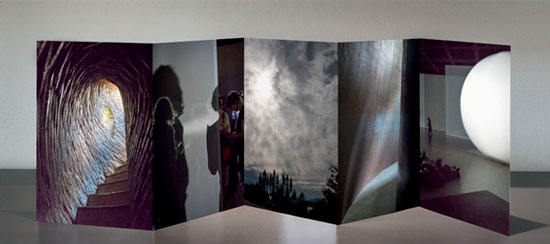
Photography and text: Rosemarie Zens
Design: Tom Mrazauskas
27 photos, texts in English
22.5×29.5 cm, 48 pages
Six leporellos in a sleeve
Edition of 500
Brave Books, Berlin, 2017
ISBN 978-3-947312-00-9
Available from:
artbooksonline.eu
As the Eye Wanders at lensculture and compiled
and in Spot (Houston Center for Photography), p. 50 (PDF):
Rosemarie Zens is an artist whose work seems to live happily in the pages of books. I was presented with three beautifully crafted books, each with a different feel but still following Zens’ delicate eye for storytelling through imagery. As the Eye Wanders, was particularly effective and was presented accordion style.
“To present the sequences in a series as an art object, almost like a sculpture or in a concertina-style book—having the images stand or line up—the flat two-dimensional photographs are augmented to three or more dimensions. Not only is the interplay between content and form of significance, but also between various kinds of presentation.”
With this presentation method, she allows the viewer to consider these five paired images and how they speak to each other. The meaning wanders along the horizontal plane, challenging the viewer as they take in each image and consider their contribution to the story. Zens shows how sequence, presentation, and dimension play an important role in the viewer’s experience and final comprehension of the artist’s story.
https://hcponline.org/spot/presenting-the-photobook/